Britain’s first use of its March interdiction powers against a Russian shadow tanker signals tighter enforcement in European waters and raises immediate risks for the wider dark fleet.
Advertisement
Advertisement
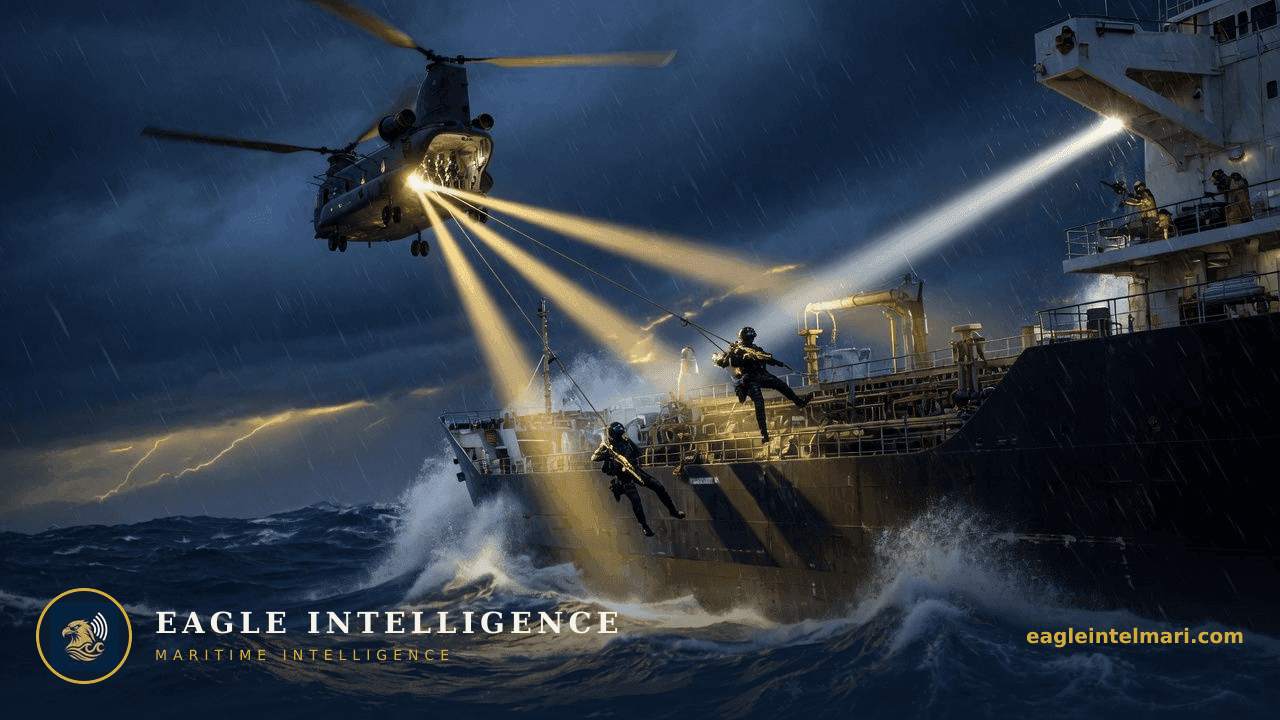
The United Kingdom has executed its first military seizure of a Russian shadow tanker under fresh authority granted in March, boarding MT Smyrtos for six hours in the English Channel and demonstrating a willingness to project force directly against sanctions-evading vessels.
Royal Marine Commandos supported by National Crime Agency officers executed a night-time boarding from a Chinook helicopter, the first operational demonstration of powers announced three months earlier. The six-hour duration suggests a methodical evidence-gathering process rather than a simple stop-and-search, indicating that future operations will likely involve detailed documentation of ownership chains, insurance status and cargo origin.
The English Channel remains the highest-density shipping corridor in Europe, carrying roughly 400 large tankers monthly. Any vessel transiting between the North Sea and Atlantic now faces elevated probability of boarding. Operators previously routing through the Dover Strait to avoid scrutiny in the Mediterranean will have to weigh the new UK risk against longer detours around Scotland or the Bay of Biscay.
Most shadow tankers operate with opaque or non-Western insurance arrangements. The visible involvement of UK law-enforcement officers raises the prospect that clubs could face sudden detention orders or liens if MT Smyrtos’s cargo proves sanctionable. Hull insurers will likely review war-risk premiums for any vessel with Russian beneficial ownership calling European ports, potentially adding several hundred thousand dollars per voyage within weeks.
The boarding party’s composition—marines plus civilian investigators—implies crews may now be detained for questioning rather than simply released. Seafarers on similar vessels will factor personal legal risk into employment decisions, accelerating the already acute shortage of officers willing to serve on dark-fleet tonnage. Flag registries that have tolerated opaque ownership structures face diplomatic pressure to delist vessels or risk secondary sanctions themselves.
First, sustained UK enforcement could push another 15–20 tankers out of European waters, lengthening average voyage times to Asia by 8–12 days and tightening VLCC availability for legitimate cargoes. Second, Moscow may accelerate reflagging to states with minimal UK diplomatic leverage, triggering a new round of flag-state designations. Third, coordinated EU-NATO action could extend similar boarding authority to additional member navies, creating a contiguous enforcement zone from Gibraltar to the Baltic.
Brent and Urals differentials already embed a sanctions premium; visible interdictions add a physical-risk layer that traders will model into freight derivatives. Charterers of non-sanctioned Russian-origin cargoes will demand clearer title warranties, lengthening negotiation cycles and pushing some volumes onto longer-haul routes served by compliant tonnage.
Advertisement
Advertisement
⚠️ Intelligence Disclaimer: This analysis is produced by Eagle Intelligence's AI-assisted automated analysis system and is provided for informational purposes only. See our editorial standards. It is not a substitute for official maritime safety advisories from UKMTO, MSCHOA, IMO, or flag state authorities. Operational decisions should always be based on official guidance and professional judgment. Eagle Intelligence accepts no liability for any loss arising from reliance on this content.
Live chokepoint status, war-risk shifts, and the daily maritime wire, straight to your inbox. Free.
Leave a comment
All comments moderated for quality
