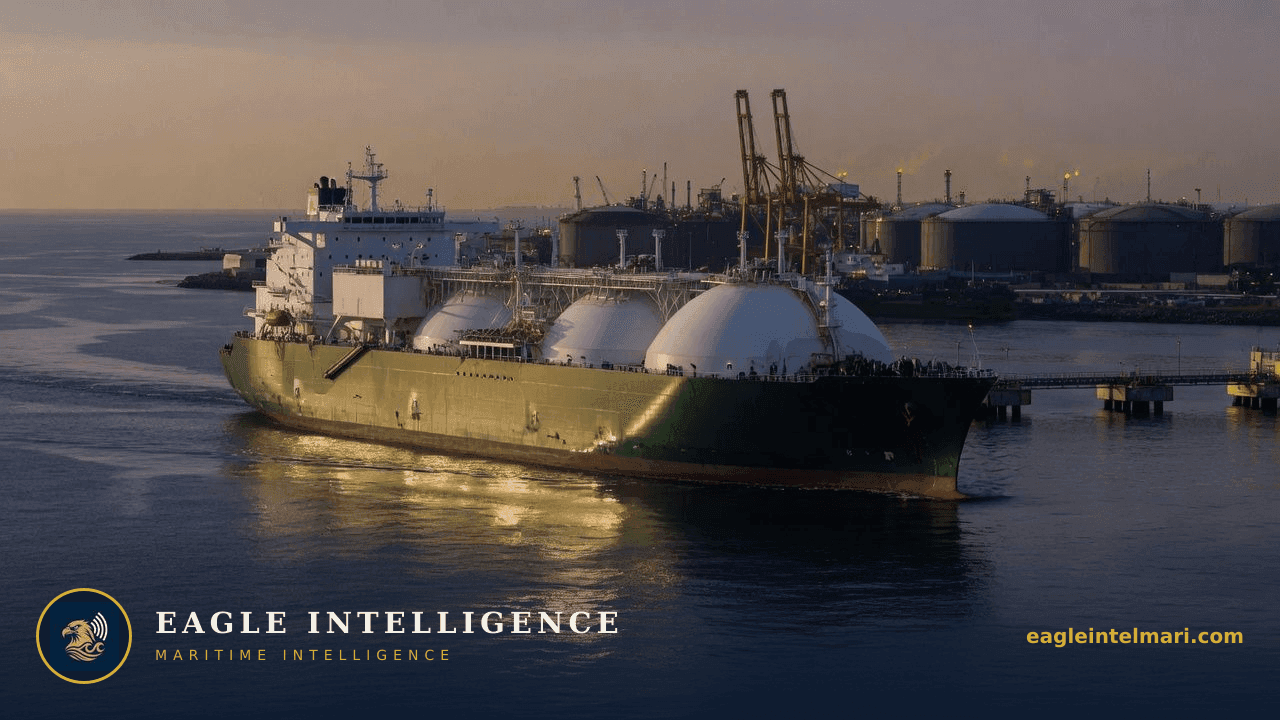
India’s first indigenous LNG tanker has reached Dahej after transiting the Strait of Hormuz, giving the country its first owned gas carrier and a new lever in energy-transport security.
Advertisement
Advertisement
The delivery of the Disha to Dahej terminal after its Hormuz passage signals that New Delhi now possesses sovereign hull capacity for at least part of its LNG supply chain, a shift with immediate consequences for charterers, insurers and regional freight balances.
Built at Cochin Shipyard, the Disha completed its first loaded transit of the Strait of Hormuz before berthing at Petronet’s Dahej facility. The voyage tested both the vessel’s technical systems and the operational chain that will allow Indian-flagged LNG carriers to move gas from Qatar and other Gulf suppliers without immediate reliance on foreign tonnage. For a nation that imports roughly 70 percent of its LNG via third-party vessels, the milestone removes one layer of charter dependency on a route that remains the most direct but also the most exposed.
Dahej already handles more than 15 million tonnes of annual regasification capacity. With an Indian-owned carrier now on rotation, terminal operators can optimise scheduling around national rather than international vessel availability. This matters during peak summer demand when spot LNG cargoes surge and foreign carriers often divert to higher-paying European or Asian buyers. Charterers serving Gujarat and northern India will now have a domestic option that avoids currency and availability risk tied to international pools.
Major Indian buyers such as Petronet LNG and GAIL have historically relied on time charters from Greek, Japanese and Korean owners. The Disha introduces a new benchmark: an Indian-flagged, Indian-crewed vessel whose operating costs and crewing regulations fall under domestic rules. Charterers may press international owners for rate concessions on comparable routes, while energy traders could structure hybrid portfolios that allocate the Disha to shorter-haul or politically sensitive cargoes. The effect will be gradual; one vessel does not shift global LNG freight balances, yet it establishes a precedent for future Indian newbuildings.
P&I clubs and hull underwriters will now assess an Indian-flagged LNG carrier for the first time in modern history. War-risk loadings for Hormuz transits remain a key variable. Early indications suggest modest savings versus foreign tonnage because the vessel operates under Indian jurisdiction and benefits from bilateral naval coordination with Gulf states. However, any future escalation in the Strait will test whether Indian hulls receive preferential treatment or face the same premium spikes applied to all carriers. Hull values and loss-of-hire terms will serve as market signals for the next wave of domestic LNG construction.
If Indian shipyards secure two to three additional LNG orders within 18 months, the fleet could reach four to five vessels by 2028, enabling roughly 8–10 percent of national imports to move on national tonnage. Should Hormuz tensions rise sharply, policymakers may accelerate cabotage-style protections for Indian carriers on Gulf–India runs, tightening availability for foreign owners. Conversely, if global LNG freight rates collapse, the economic case for further domestic builds weakens and the Disha may remain an isolated prestige asset rather than the start of a scalable fleet.
The arrival therefore functions less as a single-ship story and more as a policy signal: India has crossed the technical threshold for sovereign LNG transport and now faces the commercial and security choices that follow.
Advertisement
Advertisement
Live Hormuz transit status and war-risk band.
⚠️ Intelligence Disclaimer: This analysis is produced by Eagle Intelligence's AI-assisted automated analysis system and is provided for informational purposes only. See our editorial standards. It is not a substitute for official maritime safety advisories from UKMTO, MSCHOA, IMO, or flag state authorities. Operational decisions should always be based on official guidance and professional judgment. Eagle Intelligence accepts no liability for any loss arising from reliance on this content.
Live chokepoint status, war-risk shifts, and the daily maritime wire, straight to your inbox. Free.
Leave a comment
All comments moderated for quality
