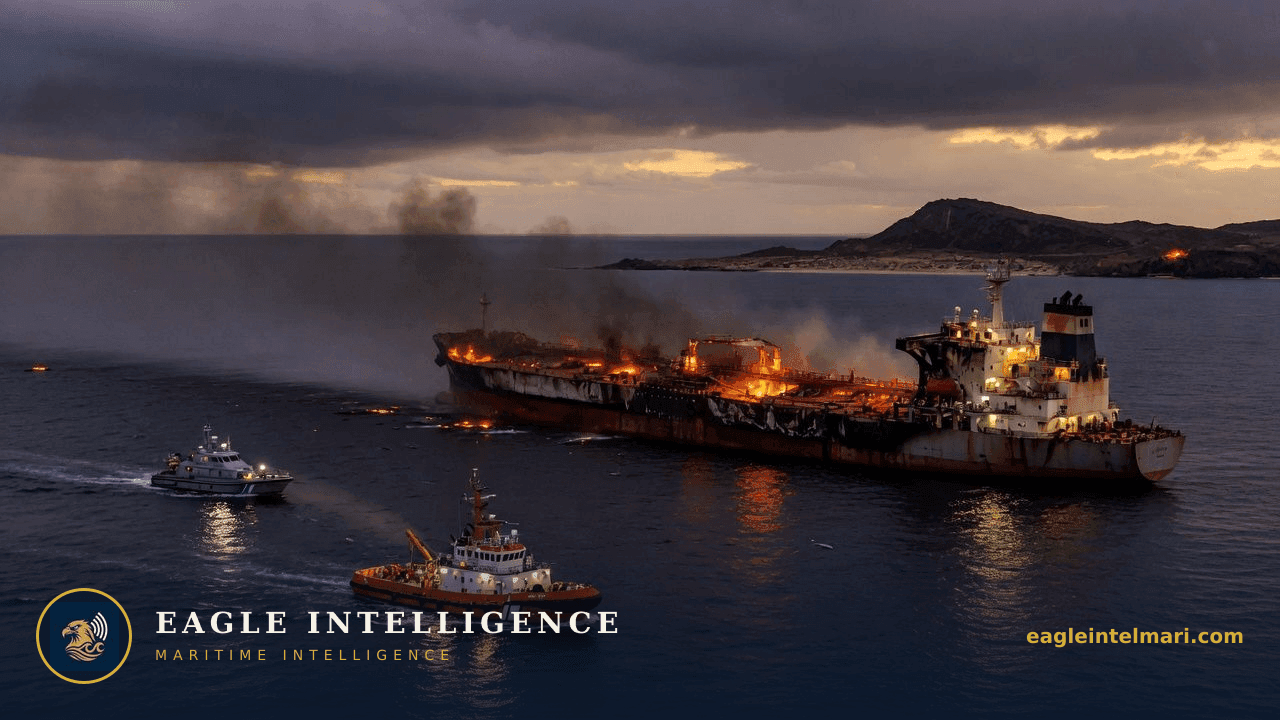
A suspicious fire forced the full crew evacuation of a tanker off Oman’s Masirah Island on 8 June, drawing an immediate coordinated response from Omani and Indian authorities and exposing persistent vulnerabilities on one of the busiest tanker corridors.
Advertisement
Advertisement
A tanker fire off Masirah Island on 8 June forced the complete evacuation of its crew and activated a joint Omani-Indian response, underscoring how quickly routine transits through the Arabian Sea can turn into multi-national emergencies.
Omani authorities led the initial surface response while Indian assets provided additional search-and-rescue capacity, demonstrating the practical interoperability that has developed between the two services in these waters. The speed of the joint operation limited any immediate loss of life, yet the necessity of involving two separate flag and coastal states illustrates how even a single vessel incident now routinely crosses national boundaries.
The description of the fire as suspicious immediately elevates the incident above routine engineering failures. In the current environment of heightened regional tension, any unexplained blaze on a tanker triggers questions about possible sabotage, mechanical tampering or opportunistic attack. Flag states and hull underwriters will therefore treat the vessel’s last port calls and crew changes with heightened scrutiny rather than accepting a standard machinery-space explanation.
All personnel were safely removed, yet the logistics of medical checks, temporary accommodation and eventual repatriation fall to both the vessel’s managers and the two coastal states involved. Seafarers from third countries often face extended administrative delays when incidents occur in remote locations such as Masirah; P&I clubs will therefore track welfare costs closely and may face pressure to advance funds for charter flights and consular support.
Although the fire occurred outside the formal high-risk area defined by the Joint War Committee, the suspicious label will prompt hull and P&I syndicates to review their exposure on similar tonnage transiting the same corridor. Even a modest uptick in additional premium could materialise within days if further details suggest external interference, affecting both the specific vessel and peer vessels on comparable routes.
Tankers passing Masirah typically maintain steady speeds to meet loading windows at Gulf terminals or discharge schedules in Asia. Any temporary exclusion zone or heightened military presence will force masters to adjust courses or reduce speed, producing small but cumulative delays that ripple into demurrage calculations for charterers and laytime disputes for owners. Ports in the region may also increase security vetting for inbound tankers that recently transited the same waters.
If the cause is confirmed as accidental, the episode will fade within weeks and serve mainly as a reminder to maintain rigorous hot-work and maintenance protocols. Should evidence point to external interference, regional naval patrols are likely to increase and war-risk premiums could widen by several basis points within a month. A prolonged investigation without clear attribution would leave the market in limbo, sustaining elevated vigilance and delaying fixture negotiations for vessels on the Oman–India leg.
The episode therefore functions less as an isolated casualty and more as a stress test of the coordination mechanisms, insurance markets and seafarer-support systems that underwrite safe passage through one of the world’s most heavily trafficked energy corridors.
Advertisement
Advertisement
⚠️ Intelligence Disclaimer: This analysis is produced by Eagle Intelligence's AI-assisted automated analysis system and is provided for informational purposes only. See our editorial standards. It is not a substitute for official maritime safety advisories from UKMTO, MSCHOA, IMO, or flag state authorities. Operational decisions should always be based on official guidance and professional judgment. Eagle Intelligence accepts no liability for any loss arising from reliance on this content.
Live chokepoint status, war-risk shifts, and the daily maritime wire, straight to your inbox. Free.
Leave a comment
All comments moderated for quality
